
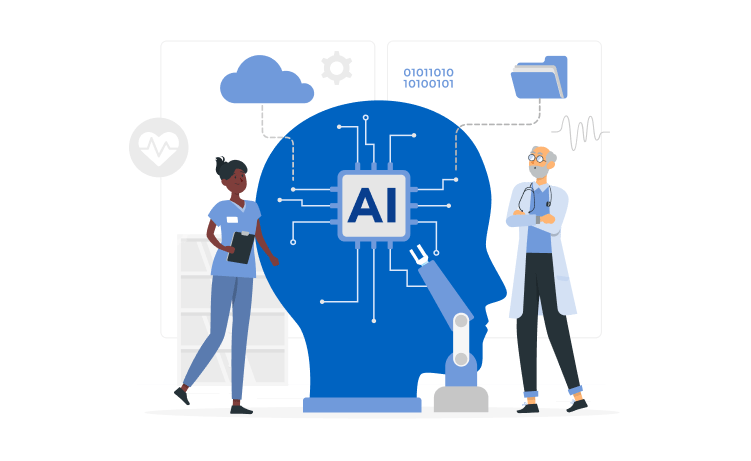
In today’s rapidly evolving digital landscape, Artificial Intelligence (AI) has emerged as a transformative force, reshaping industries and enhancing human experiences. From healthcare to finance, manufacturing to entertainment, AI is proving its worth by unlocking unprecedented opportunities and efficiencies. In this article, we will explore various AI use cases and applications that highlight the technology’s profound impact on our world.
Healthcare and Medical Diagnostics
AI’s integration into the healthcare sector has been a game-changer. It’s not just about chatbots and appointment scheduling. AI is revolutionizing medical diagnostics. Medical professionals are leveraging AI algorithms to interpret medical images such as X-rays, MRIs, and CT scans. This has led to quicker and more accurate diagnoses, significantly improving patient outcomes.
Moreover, AI is being used to analyze patient data to identify potential health risks, leading to more proactive and personalized healthcare. Wearable devices equipped with AI can monitor vital signs in real-time and alert individuals and healthcare providers to any irregularities.
Financial Services and Fraud Detection
AI is reshaping the financial services sector by enhancing security and fraud prevention. Advanced machine learning algorithms can analyze vast datasets to identify unusual patterns and flag potentially fraudulent transactions in real-time. This has not only saved financial institutions billions but also increased the confidence of customers in digital banking.
Furthermore, AI-driven chatbots and virtual assistants are transforming customer service, providing quick and accurate responses to inquiries and resolving issues more efficiently. This has not only reduced costs but also improved the overall customer experience.
Manufacturing and Predictive Maintenance
In the manufacturing industry, AI is making strides in predictive maintenance. By analyzing data from sensors and IoT devices, AI can predict when equipment is likely to fail, allowing for timely maintenance. This not only reduces downtime but also prevents costly breakdowns and accidents.
AI-powered robots are also being used to perform repetitive and dangerous tasks with precision, enhancing both efficiency and safety on the factory floor. This use of AI in manufacturing has been instrumental in the automation of various processes.
Entertainment and Personalization
Entertainment platforms are increasingly harnessing the power of AI to offer personalized experiences. Streaming services like Netflix and Spotify use AI algorithms to recommend content based on user preferences. These recommendations are often so accurate that they keep users engaged and coming back for more.
Additionally, AI is used in video game development to create more immersive and challenging gaming experiences. Virtual reality (VR) and augmented reality (AR) are also benefiting from AI, enhancing the realism and interactivity of these technologies.
E-commerce and Customer Insights
E-commerce businesses leverage AI for personalized shopping experiences. Recommendation engines analyze a user’s browsing and purchase history to suggest products they are likely to be interested in. This increases sales and customer satisfaction.
AI is also used for inventory management. By analyzing sales data and external factors, businesses can predict demand more accurately and optimize their supply chain. This reduces overstocking and understocking issues, leading to cost savings.
Agriculture and Precision Farming
Agriculture is experiencing a digital revolution through AI. Farmers are using AI to optimize crop yields, reduce waste, and minimize resource usage. AI-powered drones and sensors can monitor crop health, soil conditions, and weather, providing farmers with real-time data to make informed decisions.
Precision farming also includes autonomous tractors and harvesters that can work around the clock, increasing productivity. This not only benefits farmers but also contributes to more sustainable and efficient agricultural practices.
Transportation and Autonomous Vehicles
AI is at the forefront of the transportation industry’s transformation. Autonomous vehicles are becoming a reality, with AI algorithms handling everything from navigation to collision avoidance. These vehicles have the potential to reduce accidents, lower transportation costs, and provide greater mobility for people with disabilities.
Moreover, AI-driven traffic management systems can optimize traffic flow, reducing congestion in urban areas. This not only saves time but also reduces fuel consumption and emissions, contributing to a more sustainable future.
Energy and Smart Grids
AI is playing a crucial role in the energy sector through the development of smart grids. These grids use AI to monitor and adjust energy distribution in real-time. By predicting energy consumption patterns, AI can optimize energy production and distribution, reducing waste and costs.
Renewable energy sources, such as solar and wind, benefit from AI in predicting weather conditions and optimizing energy production. This promotes the adoption of clean energy solutions, contributing to a greener planet.
Education and Personalized Learning
AI is reshaping education by enabling personalized learning experiences. Adaptive learning platforms use AI to tailor educational content to individual students’ needs and learning styles. This not only improves learning outcomes but also makes education more accessible and engaging.
Additionally, AI can assist educators in automating administrative tasks, allowing them to focus more on teaching. Language learning apps and chatbots are also using AI to teach languages in an interactive and engaging way.
Environmental Monitoring and Conservation
AI is a powerful ally in environmental monitoring and conservation efforts. AI-driven drones and sensors are used to track wildlife, monitor deforestation, and analyze climate data. This helps scientists and conservationists make data-driven decisions to protect our planet.
In ocean conservation, AI is used to track and protect marine life. AI-powered image recognition software can identify species and monitor their populations, aiding in efforts to preserve fragile ecosystems.
Conclusion
Artificial Intelligence is no longer a concept of the future; it is an integral part of our present reality. The diverse AI use cases and applications highlighted in this article showcase how this technology is transforming industries and improving our lives in countless ways. As AI continues to evolve, it’s essential for businesses and individuals to adapt and harness its potential, contributing to a brighter, more efficient, and sustainable future. AI isn’t just a buzzword; it’s a driving force behind innovation and progress across various domains, and it’s here to stay.
 Development Services