Harness the transformative potential of Generative AI to streamline operations, enhance decision-making, and achieve breakthrough business outcomes. Our expert generative AI consulting services empower you with AI-driven automation, content creation, and intelligent data insights—helping you outpace the competition.
Leading Enterprises Trust Us
We have successfully delivered 200+ AI projects, working with leading enterprises across industries. Our expertise in generative AI consulting ensures that businesses can effectively implement AI-driven strategies for sustainable growth.
Our Generative AI Consulting Services
We specialize in helping you leverage the power of Generative AI to drive innovation and efficiency. Our gen AI consulting services include:
Strategic Generative AI Roadmap We collaborate to define clear objectives, identify high-impact AI opportunities, and develop a tailored roadmap for successful generative AI consulting implementation. This includes assessing your current infrastructure and data readiness for generative models.
Custom Generative AI Solution Development Our team builds custom Generative AI solutions designed for your specific data and business needs. Whether you require a brand-new generative solution or enhancements to an existing one, we deliver AI-driven innovation.
Rapid Prototyping & Proof of Concept We create AI prototypes to validate generative applications early, allowing for feasibility assessment, iterative improvements, and seamless scaling.
Integration & Deployment We ensure smooth generative AI integration into your existing workflows, from API connections to cloud-based deployments, enabling maximum efficiency.
Training & Enablement We provide tailored training programs and ongoing support to empower your team with gen AI consulting expertise, ensuring effective AI adoption.
Our Approach to Delivering End-to-End Generative AI Solutions
We transform strategy into action with a structured approach to generative AI consulting services, ensuring efficiency, scalability, and business impact.
Assessment & Strategy – Evaluating business needs, data readiness, and AI potential to define a clear roadmap.
Solution Development – Designing and building custom generative AI solutions aligned with your workflows.
Seamless Integration – Embedding AI into your systems with minimal disruption.
Optimization & Scaling – Refining solutions for enhanced performance and long-term adaptability.
Security & Compliance – Implementing strong governance, data privacy, and ethical AI safeguards.
Why Partner with Us?
✅ Tailored AI Strategies – Our generative AI consulting services align AI solutions with your business goals to maximize impact. ✅ Seamless Integration – We ensure smooth adoption with minimal operational disruptions. ✅ Scalable & Future-Ready Solutions – Our AI models adapt to evolving business needs. ✅ Secure & Compliant – We prioritize data security, ethical AI practices, and regulatory compliance. ✅ Measurable ROI – Our AI-driven solutions optimize workflows, reduce costs, and unlock new revenue opportunities.
Industries We Empower
🔹 Finance & Banking – AI-driven automation for document processing, fraud detection, and financial insights. 🔹 Healthcare – Enhanced patient care, streamlined medical documentation, and accelerated drug discovery. 🔹 Retail & E-commerce – Personalized shopping experiences, dynamic content generation, and smart recommendations. 🔹 Manufacturing & Supply Chain – AI-powered demand forecasting, precision quality control, and supply chain automation. 🔹 Marketing & Sales – Hyper-personalized content, automated campaigns, and data-driven sales strategies.
Conclusion
Generative AI is revolutionizing industries, offering businesses unparalleled opportunities for innovation and efficiency. With our gen AI consulting expertise, we help organizations navigate this transformation seamlessly—delivering customized AI solutions that enhance decision-making, streamline operations, and drive measurable results.
🚀 Ready to leverage the power of generative AI consulting services? Contact us today to explore how our expertise can transform your business.
In today’s rapidly evolving technological landscape, artificial intelligence (AI) has emerged as a game-changer for businesses across various industries. Leveraging AI can help you streamline operations, enhance customer experiences, and gain a competitive edge. However, navigating the complex world of AI development requires the expertise of a reliable AI Development Company. In this article, we’ll explore how partnering with a top-notch AI development company can supercharge your business and why Xicom stands out in this field.
Why AI Matters for Your Business
AI is no longer a buzzword; it’s a powerful tool that can transform the way businesses operate. It empowers companies to:
Enhance Efficiency: AI automates routine tasks, reducing operational costs and freeing up your workforce to focus on more valuable tasks.
Deliver Personalized Experiences: AI-driven insights allow you to understand your customers better and tailor products and services to their specific needs.
Improve Decision-Making: AI algorithms analyze vast amounts of data to provide valuable insights that can drive strategic decisions.
Enhance Security: AI can identify and mitigate potential security threats more effectively than traditional methods.
Why You Need an AI Development Company
Developing AI solutions can be a complex and resource-intensive process. That’s where a reputable AI development company comes into play. Here’s why you should consider partnering with one:
Expertise: AI Development Companies like Xicom have a team of skilled professionals with extensive knowledge in AI. They understand the latest trends, technologies, and best practices, ensuring your project is in safe hands.
Custom Solutions: Every business has unique needs. A dedicated AI development company will work with you to create custom AI solutions that align with your goals and requirements.
Cost-Efficiency: Outsourcing your AI development is often more cost-effective than hiring an in-house team. You can access a wide range of expertise without the added overhead.
Speed to Market: AI Development Companies can expedite your project, getting your AI solutions to market faster.
Why Xicom Stands Out
When it comes to choosing an AI Development Company, Xicom is a standout choice. Their services are comprehensive and tailored to your specific needs. Here’s why Xicom is a top choice:
Proven Track Record: With years of experience in the field, Xicom has a proven track record of delivering successful AI projects across various industries.
Innovation: They stay at the forefront of AI innovation, ensuring your solutions are built using the latest technologies and methodologies.
Scalability: Xicom’s solutions are designed to scale with your business, ensuring they continue to meet your evolving needs.
Client-Centric Approach: Xicom believes in open communication and collaboration. They work closely with clients to understand their goals and vision, ensuring the delivered AI solutions align with their objectives.
Conclusion
The impact of AI on businesses is undeniable. To leverage the full potential of AI, partnering with an AI Development Company is a strategic move. Xicom, with its extensive experience, innovative approach, and client-centric philosophy, is a reliable partner in this journey.
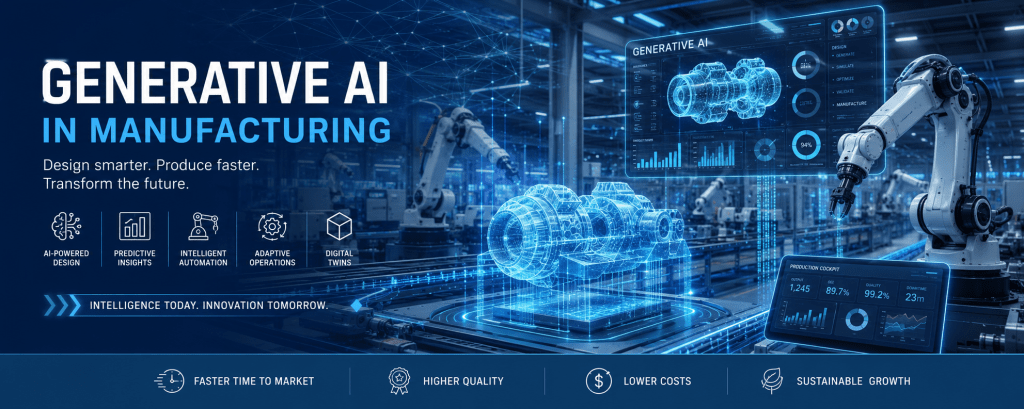
Manufacturing is undergoing its most significant transformation since the industrial revolution. The convergence of the Internet of Things (IoT), Big Data, and Artificial Intelligence is turning traditional factories into smart, data-driven powerhouses and at the center of this revolution sits Generative AI.
The global generative AI in manufacturing market is expected to grow from $630.72 million in 2025 to $13,893.51 million by 2034, expanding at a CAGR of 41%. This explosive growth is not a coincidence it reflects a fundamental shift in how manufacturers design products, manage supply chains, maintain equipment, and compete globally.
According to Rockwell Automation’s State of Smart Manufacturing report, 95% of manufacturers have either adopted or plan to adopt smart manufacturing technologies within the next 1–2 years, with 83% of respondents anticipating using GenAI in operations.
What is Generative AI in Manufacturing?
Generative AI is a branch of artificial intelligence that creates new content designs, code, text, simulations, and predictions — by learning patterns from existing data. Unlike traditional AI that simply analyzes or classifies, generative AI actively produces original outputs.
In manufacturing, this means the technology can autonomously generate new product designs, simulate production scenarios, predict equipment failures, optimize supply chains, and create quality control frameworks all from data that manufacturers already possess.
Common generative AI architectures used in manufacturing include Generative Adversarial Networks (GANs) for synthetic data generation and design simulation, Variational Autoencoders (VAEs) for anomaly detection in quality control, and large language models (LLMs) like GPT for documentation, knowledge management, and operator support.
Why Generative AI is Becoming Non-Negotiable in Manufacturing
Modern manufacturers face a perfect storm of pressures. Estimates suggest that firms will lose 45% of their average annual earnings over the next decade due to supply chain disruptions, while more than 54% of manufacturers are already facing significant labor shortages.
Generative AI directly addresses these pain points automating knowledge-intensive tasks, reducing dependency on scarce skilled labor, accelerating design cycles, and building supply chain resilience that traditional automation simply cannot match.
The global AI in manufacturing market was estimated at $5.32 billion in 2024 and is projected to reach $47.88 billion by 2030, growing at a CAGR of 46.5%. The early adopters building GenAI capabilities today will define the competitive landscape of the decade ahead.
Key Applications of Generative AI in Manufacturing
1. Generative Product Design & Optimization
One of the most transformative applications of GenAI in manufacturing is in product design. Traditional design processes are linear and constrained by human imagination and time. Generative AI breaks both barriers.
Generative design software can quickly generate a wide range of design options based on specific constraints and goals, helping speed up the design process, reduce development costs, and lead to more creative and innovative solutions.
General Motors has integrated generative AI platforms and cloud computing into its manufacturing processes to design vehicle parts and components allowing them to produce lighter components, reduce production costs, and enhance efficiency and productivity.
Engineers input parameters material type, weight limits, load requirements, cost constraints and GenAI explores thousands of viable design configurations in the time it would take a human team to evaluate a handful.
2. Predictive Maintenance
Unplanned equipment downtime is one of the most costly problems in manufacturing. Generative AI is turning predictive maintenance from a reactive process into a proactive discipline.
Tools like EOT’s Twin Talk GPT combine generative AI and edge computing to simulate events expected in an industrial environment, using that data to train machine learning algorithms that optimize equipment condition and performance.
By continuously analyzing sensor data, vibration patterns, temperature readings, and historical failure records, GenAI models predict equipment failures before they occur enabling maintenance teams to intervene at exactly the right moment, extending asset life and eliminating costly unplanned downtime.
3. Quality Control & Defect Detection
Manual quality inspection is slow, inconsistent, and expensive. Generative AI brings speed, precision, and scalability to quality control that human inspection cannot match.
GenAI models trained on thousands of images of both acceptable and defective products can identify microscopic defects, surface irregularities, and assembly errors in real time on the production line. More importantly, these models learn continuously becoming more accurate with every inspection cycle.
In 2023, Siemens and Schaeffler introduced an AI-powered copilot that assists engineers by turning prompts into working control sequences, reducing programming errors and speeding up deployment.
4. Supply Chain Optimization
In supply chain management, generative AI is used for content generation, scenario modeling, and advanced automation that enhances flexibility and communication within the supply chain.
GenAI models analyze demand signals, supplier performance data, logistics patterns, and geopolitical risk factors to generate optimized supply chain scenarios. When disruptions occur a supplier failure, a shipping delay, a demand spike GenAI can instantly model alternative sourcing strategies and recommend the best path forward.
This capability is particularly critical given the supply chain fragility exposed by recent global disruptions, where manufacturers with AI-driven supply chain resilience recovered significantly faster than those relying on traditional planning methods.
5. Digital Twins & Simulation
Digital twins virtual replicas of physical manufacturing environments are becoming one of the most powerful tools in industrial AI. When powered by generative AI, digital twins move beyond simple monitoring to active simulation and optimization.
Manufacturers can test new production layouts, simulate the impact of equipment changes, model energy consumption scenarios, and stress-test supply chain configurations all in a virtual environment before committing real resources. This dramatically reduces the cost and risk of operational changes.
One of the most underestimated applications of GenAI in manufacturing is in knowledge management. Manufacturing environments generate enormous volumes of technical documentation maintenance manuals, compliance reports, quality records, operator guides that are time-consuming to create and difficult to keep current.
LLM-based generative AI can automatically generate, update, and summarize technical documentation from operational data. More importantly, it can make that knowledge accessible to operators through natural language interfaces enabling a new technician to query complex maintenance procedures in plain language and receive accurate, contextual guidance instantly.
7. Energy Efficiency Optimization
Sustainability is no longer optional for manufacturers it is a regulatory and competitive requirement. Generative AI helps manufacturers optimize energy consumption by continuously analyzing production schedules, equipment load patterns, and energy pricing data to recommend operational adjustments that minimize energy use without compromising output.
Germany’s “Industrie 4.0” strategy and emphasis on smart factories and AI-driven automation are accelerating adoption, with the German federal government proposing significant investment toward AI research and digital infrastructure within its national AI strategy.
Real-World Industry Applications
Automotive: GenAI is used to design lighter vehicle components, optimize crash simulation testing, and streamline PLC programming on assembly lines.
Aerospace: Complex component design for aircraft engines and structural parts, where weight reduction and material performance requirements demand exploration of thousands of design variations simultaneously.
Electronics: Circuit board design optimization, component placement efficiency, and yield improvement in semiconductor fabrication.
Pharmaceuticals: Generative AI assists in designing and prototyping applications, helping engineers explore new design options quickly and adapt to changing production needs.
Consumer Goods: Mass customization at scale enabling manufacturers to produce personalized product variants without sacrificing production efficiency.
Benefits of Generative AI in Manufacturing
Accelerated Time to Market Compressing design cycles from months to weeks by generating and evaluating thousands of design options simultaneously.
Significant Cost Reduction Reducing material waste through optimized designs, cutting unplanned downtime through predictive maintenance, and minimizing quality-related rework costs.
Labor Shortage Mitigation Automating knowledge-intensive tasks that previously required scarce skilled workers from PLC programming to technical documentation.
Enhanced Product Quality Real-time defect detection and continuous quality monitoring deliver consistency that manual inspection cannot achieve.
Supply Chain Resilience Scenario modeling and demand forecasting that allows manufacturers to anticipate and respond to disruptions before they become crises.
Sustainability Improvements Energy optimization, waste reduction, and design efficiency that support environmental targets and regulatory compliance.
Challenges of Deploying Generative AI in Manufacturing
Data Quality & Availability
Generative AI models are only as good as the data they learn from. Many manufacturers operate on legacy systems that produce inconsistent, siloed, or incomplete data creating a significant barrier to model accuracy.
Integration with Legacy Infrastructure
Most manufacturing facilities run on equipment and systems that were not designed with AI integration in mind. Connecting GenAI solutions to legacy PLCs, SCADA systems, and ERP platforms requires careful planning and significant technical investment.
Cybersecurity & IP Protection
Manufacturing data designs, processes, formulations represents significant intellectual property. Deploying AI systems that process this data introduces new cybersecurity risks that must be managed with robust data governance and access controls.
Workforce Adoption
GenAI implementation requires cultural change, not just technology installation. Operators and engineers need training, clear communication about AI’s role, and confidence that the technology supports rather than threatens their positions.
Regulatory & Compliance Complexity
In regulated manufacturing sectors pharmaceuticals, aerospace, medical devices AI-generated outputs must meet strict validation and documentation requirements before they can be used in production.
How to Implement Generative AI in Manufacturing: A Step-by-Step Guide
Step 1 Identify High-Value Use Cases Start with specific pain points excessive downtime, quality failures, design bottlenecks where GenAI can deliver measurable ROI quickly.
Step 2 Audit Your Data Infrastructure Assess the quality, completeness, and accessibility of your operational data. Invest in data cleaning and integration before model development.
Step 3 Choose the Right Architecture Match your generative model to your use case GANs for design generation, LLMs for documentation and knowledge management, predictive models for maintenance optimization.
Step 4 Start with a Controlled Pilot Deploy in one production line or facility before scaling. Define clear KPIs upfront reduction in downtime, design cycle time, defect rate and measure rigorously.
Step 5 Integrate with Existing Systems Connect your GenAI solution with existing ERP, MES, and SCADA systems. Interoperability is non-negotiable for operational impact.
Step 6 Train Your Workforce Invest in structured training for engineers, operators, and maintenance teams. Adoption is the single biggest predictor of GenAI success in manufacturing environments.
Step 7 Scale & Continuously Improve Expand successful pilots across facilities with dedicated support at each stage. Implement ongoing model monitoring and retraining as operational data evolves.
The Future of Generative AI in Manufacturing
The trajectory of GenAI in manufacturing points toward a future where the boundaries between digital and physical production disappear entirely.
Autonomous Factory Design: AI will design entire production facilities layout, equipment selection, workflow optimization based on output requirements and constraints.
Human-AI Collaborative Engineering: Design teams will work alongside AI systems that continuously generate, evaluate, and refine design options in real time based on engineer feedback.
Mass Personalization at Scale: The shift from mass production to smart customization will allow manufacturers to produce individually tailored products without sacrificing the efficiency of scale.
Sustainable Manufacturing by Default: GenAI will optimize every aspect of production for environmental performance material selection, energy use, waste reduction making sustainability a built-in outcome rather than an added cost.
Global Remote Manufacturing: Cloud-based GenAI platforms will enable manufacturers to design, simulate, and optimize production processes across global facilities from a single interface.
Conclusion
Manufacturing has always rewarded those who embrace transformation early. The shift from manual labor to automated production lines defined winners for decades. The shift to Generative AI will do the same.
From generative product design and predictive maintenance to supply chain resilience and energy optimization, GenAI is touching every critical function of modern manufacturing. The organizations that treat this as a strategic priority rather than an IT experiment — will define the performance benchmark for their entire industry.
The path forward requires the right strategy, the right data foundation, and the right implementation partner. At Xicom we bring deep manufacturing domain knowledge and proven GenAI expertise to help you move from pilot to production at pace and at scale.
Ready to transform your manufacturing operations? Contact us.
In today’s rapidly evolving technological landscape, artificial intelligence (AI) has emerged as a transformative force across various industries. Among the various branches of AI, generative AI development has gained significant attention for its ability to create new and original content. In this blog post, we will delve into the world of generative AI development, its services, and the role of a leading generative AI development company like Xicom.
Understanding Generative AI Development
Generative AI development is a subfield of artificial intelligence that focuses on creating models capable of generating original and creative outputs. Unlike traditional AI approaches that rely on pre-defined rules and patterns, generative AI models learn from large datasets to generate new and unique content.
Generative AI Development Services
Generative AI development services encompass a wide range of applications across industries, including art, design, music, writing, gaming, and more. These services leverage cutting-edge machine learning algorithms to generate content that is innovative, engaging, and tailored to specific requirements. Here are a few examples of generative AI development services:
Creative Content Generation: Generative AI models can create captivating visual designs, illustrations, and artwork. By training on vast databases of images and patterns, these models can generate original content that aligns with specific artistic styles or design preferences.
Music Composition: Generative AI development allows for the creation of unique musical compositions. By learning from extensive music libraries, these models can compose melodies, harmonies, and even generate complete musical pieces, catering to various genres and moods.
Natural Language Processing: Generative AI models can be trained to understand and generate human-like text. This capability has numerous applications, including chatbots, content generation, dialogue systems, and even storytelling.
Game Development: Generative AI development plays a crucial role in creating immersive gaming experiences. By generating realistic game environments, character behaviors, and narratives, generative AI models enhance gameplay and create dynamic and engaging worlds.
Virtual Reality (VR) and Augmented Reality (AR): Generative AI development facilitates the creation of immersive virtual and augmented reality experiences. By generating realistic 3D models, textures, and interactive elements, these models enhance the visual and interactive aspects of VR/AR applications.
The Role of a Generative AI Development Company
A generative AI development company, such as Xicom, plays a vital role in harnessing the power of generative AI for businesses and individuals. Here’s why partnering with a specialized generative AI development company is crucial:
Expertise and Experience: Generative AI development companies have a team of AI experts and data scientists who possess the necessary skills and expertise to develop state-of-the-art generative AI models. Their experience in working on diverse projects equips them with the knowledge to deliver high-quality solutions.
Customization and Scalability: Generative AI development companies understand the importance of tailoring solutions to meet specific requirements. They can build customized generative AI models that align with individual preferences and business goals. Moreover, these companies have the infrastructure and resources to handle projects of varying scales.
Ethical Implementation: As generative AI development involves working with vast amounts of data, ethical considerations become paramount. A reliable generative AI development company adheres to ethical standards and ensures responsible data handling and privacy practices.
Continuous Support and Maintenance: Generative AI models require constant monitoring, updates, and maintenance. A generative AI development company provides ongoing support, ensuring that the models perform optimally and remain up-to-date with the latest advancements.
Conclusion
Generative AI development services have revolutionized the way content is created across industries. With the ability to generate original and creative outputs, generative AI models offer immense potential for businesses and individuals. By partnering with a leading generative AI development company like Xicom, organizations can unlock the power of this technology and leverage it to drive innovation and enhance customer experiences. Embrace generative AI development services and embark on a journey of limitless creativity.
Artificial Intelligence (AI) is no longer a futuristic concept; it has already permeated numerous industries, transforming the way we interact with technology and businesses operate. From enhancing customer experiences to optimizing operational efficiency, AI has become an indispensable tool in today’s digital landscape. In this blog, we will explore how AI development services have evolved and the impact they have on various sectors, with a focus on the leading AI app development company, Xicom.
AI Development Services: Empowering Businesses with Innovation
AI development services have taken the world by storm, and companies are increasingly leveraging AI to gain a competitive advantage. These services encompass a wide array of capabilities, ranging from AI software development to AI/ML development services. Whether it’s creating intelligent chatbots, predictive analytics, or recommendation systems, AI empowers businesses to make data-driven decisions and streamline their processes.
AI Software Development: The Power of Intelligent Solutions
AI software development involves creating applications and systems that can perform tasks requiring human intelligence. Xicom, a renowned AI app development company, excels in building cutting-edge AI solutions tailored to their clients’ specific needs. From integrating AI algorithms into existing software to developing AI-driven applications from scratch, their team of experts transforms business operations and enhances overall efficiency.
AI/ML Development Services: Unraveling the Magic of Machine Learning
Machine Learning (ML) is a subset of AI that focuses on developing algorithms that allow machines to learn from data and improve their performance over time. Xicom’s AI/ML development services harness the potential of ML to build smart applications that adapt to users’ behaviors and deliver personalized experiences. This has proven invaluable in domains such as e-commerce, healthcare, and finance, where understanding user preferences and behavior is crucial.
The Impact of AI Development Services Across Industries:
Healthcare: Revolutionizing Patient Care
AI development services have made significant strides in the healthcare sector, enhancing patient care and diagnostics. AI-powered medical imaging analysis enables more accurate and efficient diagnoses, while natural language processing (NLP) aids in analyzing vast amounts of medical records to provide timely insights to healthcare providers. AI-driven chatbots also streamline patient interactions and provide instant support, reducing the burden on medical staff.
E-commerce: Personalizing Shopping Experiences
AI app development companies like Xicom have played a pivotal role in transforming the e-commerce landscape. With AI-based recommendation systems, e-commerce platforms can analyze customer preferences, behavior, and purchase history to offer personalized product suggestions. This not only enhances the shopping experience but also boosts customer loyalty and sales.
Finance: Improving Fraud Detection and Risk Assessment
The finance industry is leveraging AI development services to enhance fraud detection and risk assessment. AI algorithms can analyze vast amounts of financial data in real-time, identifying suspicious activities and preventing fraudulent transactions. Additionally, AI-powered predictive analytics aids in better understanding market trends, enabling financial institutions to make well-informed investment decisions.
Manufacturing: Optimizing Operations with AI
AI development services have enabled manufacturers to optimize their operations through predictive maintenance. By analyzing sensor data from machinery and equipment, AI algorithms can predict when maintenance is required, reducing downtime and preventing costly breakdowns. AI-powered robotics and automation have also revolutionized the manufacturing sector, enhancing productivity and efficiency.
Conclusion
The advent of AI development services has opened up a realm of possibilities, transforming industries and reshaping the future of businesses. From healthcare to finance, e-commerce to manufacturing, AI has become an indispensable part of modern enterprises. Leading AI app development companies like Xicom have been instrumental in driving innovation and empowering businesses to harness the true potential of AI.
As AI continues to evolve, we can expect even more groundbreaking applications and advancements across various sectors. As businesses recognize the value of AI development services, embracing this technology will be the key to staying ahead in the ever-evolving digital landscape. The future is undoubtedly exciting, and AI development services will undoubtedly play a pivotal role in shaping it.



 AI & Tech Blogs