Uncategorized

Software Development Services

In today’s world, software development has become an essential part of businesses across industries. Whether it’s a small startup or a large corporation, software is needed to automate processes, manage data, and provide a better user experience. However, not every business has the expertise to develop high-quality software that meets their specific needs. That’s where a software development company comes in.

A software development company is a company that specializes in developing custom software solutions for businesses. They offer a range of software development services, including software consulting, design, development, testing, and maintenance. These services can be tailored to the specific needs of a business, ensuring that they get the exact software solution they need.

One such software development company is LeewayHertz. They have been providing software development services to businesses for over a decade. Their team of experienced developers, designers, and project managers work together to deliver high-quality software solutions that meet their clients’ needs.

LeewayHertz offers a range of software development services, including mobile app development, web development, blockchain development, and AI/ML development. They use the latest technologies and frameworks to develop custom software solutions that are scalable, reliable, and secure.

In addition to their software development services, LeewayHertz also offers software consulting services. They work closely with their clients to understand their business needs, analyze their existing software infrastructure, and identify areas where software can be used to improve efficiency and productivity. Their consulting services help businesses make informed decisions about software development, ensuring that they get the most value from their investment.

When it comes to software development, quality is paramount. LeewayHertz understands this and has a rigorous quality assurance process in place to ensure that their software solutions meet the highest standards. They follow industry-standard coding practices and conduct thorough testing at every stage of development to catch any bugs or issues before the software is deployed.

Working with a software development company like LeewayHertz has many benefits for businesses. First and foremost, it allows businesses to focus on their core competencies while leaving software development to the experts. This frees up time and resources, enabling businesses to achieve their goals more efficiently.

Furthermore, software development companies have a deep understanding of the latest technologies and frameworks, allowing them to develop software solutions that are innovative and effective. They also have experience working with businesses across industries, giving them a broad perspective on the challenges and opportunities facing different businesses.

In conclusion, software development is a crucial aspect of modern businesses, but not every business has the expertise to develop high-quality software solutions. This is where software development companies like LeewayHertz come in. They offer a range of software development services, including consulting, design, development, testing, and maintenance, to help businesses achieve their goals. Their experience, expertise, and commitment to quality make them a trusted partner for businesses looking to leverage software to improve their operations.

Standard
Uncategorized

An Overview of Crypto Swapping and the Benefits of Using a Whitelabel Platform

The crypto market is constantly expanding, and new tokens are being added daily to the crypto list. Each new token represents new value and an opportunity to invest differently. In fact, these alternative tokens are getting more attention from businesses and consumers to use them for transactions or as long-term investments.

Eventually, the variety of cryptocurrency options forces us to swap one crypto for another – just as we do for dollars, euros and yen. However, to acquire the currency one desire, it is important to understand how to swap tokens effectively. Platforms like Uniswap, Pancakeswap, Sushiswap and Bancor are popular as leading crypto swap platforms. 

As businesses or investors start betting on such platforms to reap huge benefits, adopting a whitelabel crypto swap is becoming a new trend. In this guide, we’ll go through the basic concept of crypto swapping and the benefits of having a whitelabel crypto swap platform. 

What is a crypto swap? 

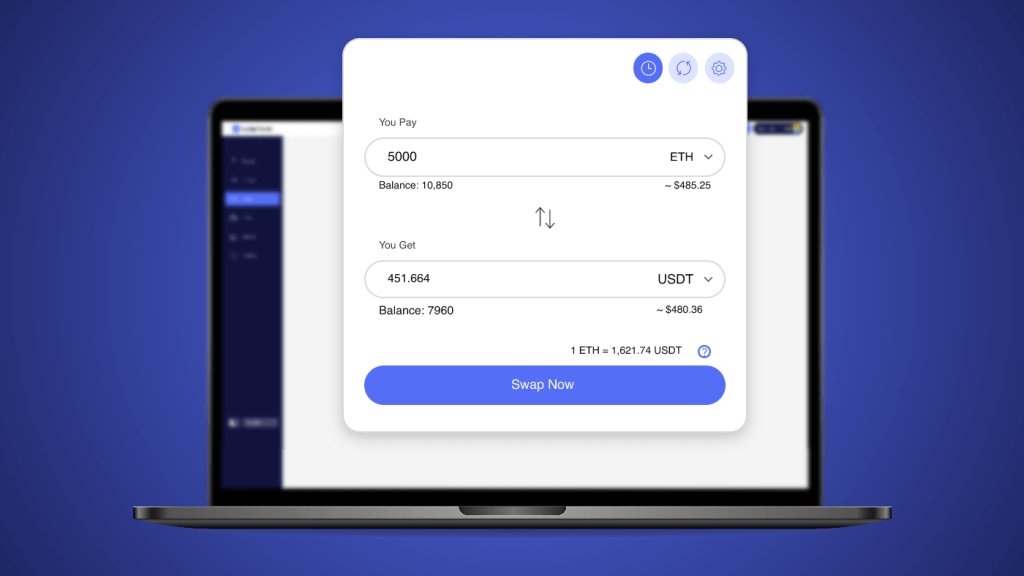
Crypto swapping is the process of trading one cryptocurrency for another instantly at an equivalent value. Any crypto asset can directly be exchanged for another without any third-party intervention or crypto-to-fiat exchange required. Crypto users participating in swapping can save time and pay less in fees. 

Crypto tokens are the keys to utilizing the benefits of any native blockchain ecosystem. Token holders of a particular blockchain platform can vote on community governance and guide the platform’s future. At the same time, crypto swap is helping crypto users to explore the further reaches of the blockchain. By exchanging one crypto asset for another, swapping allows them to be part of multiple projects they wish to support. 

Difference between crypto swap and exchange

Many may find the words swapping and exchange as synonyms, but in the crypto world, they are slightly different. Although they achieve the same outcome – starting with one coin and ending with another, the actual process of doing it is quite different in each case. 

In crypto swapping, crypto assets are directly converted to one another either to be used as payment or to avoid slippage costs or other high transaction fees. Crypto swap allows instant transactions and does not require exchanging crypto for fiat. Thus, swapping is a more flexible process. 

In the case of crypto exchange, the process involves buying and selling cryptocurrencies. One crypto is traded for another crypto or fiat currency based on its current market price. There are specific trading pairs involved in the crypto exchange. For example, BTC/USDT. However, users may get hit with high commissions or transaction fees using a crypto exchange.

What is a whitelabel crypto swap, and what are its business benefits? 

It is easy to design, develop, and deploy white-label crypto exchange platforms. They can be easily customized and contribute to the development of a robust crypto swap platform. Launching such platforms encourages the mass adoption of cryptocurrencies. Users can easily swap currencies at their convenience, fueling strong liquidity in the crypto market. Besides, whitelabel crypto swap platforms allow businesses to work together and meet the demands of an ever-changing market. Thus, in the fast-growing world, easily deployable whitelabel crypto swap platforms are the key to success. 

Features of whitelabel crypto swap platforms 

Instant transactions: Using such platforms, swapping within exchange pairs can be done in less than a few minutes. 

Limitless swaps: There are no limits on how much crypto can be swapped when using whitelabel crypto swap platforms. 

Easy integration: They are integrable with all kinds of wallets, DeFi exchange, and trading platforms. 

Cross-chain swaps: Whitelabel crypto swap platforms allow for cross-chain swaps for almost all popular cryptocurrencies. 

Conclusion 

Crypto swapping has become the most dominant factor in the crypto market. This is because they offer users maximum flexibility. Crypto swap allows the user to obtain crypto coins in exchange for another coin of the same worth. Here no fiat currency is involved throughout the process. The crypto swap platform allows for quick and smooth swapping of crypto tokens. Such platforms are ideal for businesses or investors as they are fully decentralized, with no central authority controlling transactions. Smart contracts make the execution process automatic when certain conditions are met. If you plan to build a swapping platform, whitelabel crypto swap offers the best solution. It will make the development and integration process seamless and in less time.

Standard
Uncategorized

How Proof of Reserve Establishes Transparency for DeFi Platforms

The recent collapse at FTX, one the largest cryptocurrency and DeFi exchanges, has shaken the space. The collapse of FTX, one of the largest exchanges in the world, has made it the talk and caused many to reconsider investing in cryptos. The crash caused by FTX’s lack of liquidity, its mismanagement of money and the questionable practices of its administrators led to it being taken down along with other exchanges, as well the value of important coins like Bitcoin and Ethereum. This significant incident has demonstrated once more the importance to verify liabilities for exchanges as well as custodial organizations.

It is essential to ensure checks and balances are in operation in the decentralized crypto environment. There were many instances of bankruptcies in traditional financial institutions before the FTX crashed. It is important to have a formalized procedure to verify liabilities. This can prove to be complicated and requires the services of a third party auditor to conduct a thorough assessment. The standard practice for assessing the checks and balances of DeFi platforms or exchanges is to conduct a Proof of Reserve Audit.

What is Proof-of-Reserve?

Proof of Reserve is a method that proves that an exchange platform holds the amount claimed. It is an auditing method that addresses the transparency concerns surrounding assets on exchanges. It is a vital inspection technique to ensure real assets are returned crypto in a decentralized area.

Proof of Reserve refers specifically to due diligence. Trusted third-party auditors examine the statements of crypto projects and present a clear picture of all reserves owned by the company. Proof of Reserve audit is an effective way to improve transparency and trust in the crypto market. It allows custodians to be held accountable by customers of exchanges and custodial services. It informs users about the status of their liabilities and how much crypto they have.

Why is Proof of Reserve so important?

Custodial platforms in the crypto world keep their users’ assets in a hot account, which can be used to fulfill withdrawal requests. A portion of the user’s deposits is kept in cold wallet storage. Customers can make deposits using a wallet address. They can move between the hot and cold wallets.

Custodial financial platforms don’t provide full custody of assets. Instead, they keep private keys that allow them to access these addresses. By tracing transactions that involve cold or hot wallets of custodial institutions, we can access the details about assets. But it must pinpoint individual users’ portions of the total assets. It shows only a total view of all assets on the custodial platforms. This lack of knowledge can cause distrust among users.

The proof of Reserve audit can be used in this scenario to do an in-depth investigation of the total assets of the institution, and determine what share of these assets each user owns.

Proof of Reserve is a combination of transparency in asset management as well as the privacy of customer assets. A platform that does not commit to 100% Proof of Reserve is at risk.

  • There is a risk that the assets of the users could be misappropriated.
  • Inefficiency or delay when cashing out assets.
  • Inability of cashing out assets during crowded withdrawals
  • Suffer assets losses or bankruptcy.

DeFi platforms need to regularly perform Proof of Reserve Audits in order for them to keep track of their checks and balances.

Let us now see how Proof of Reserve audits are done.

How does Proof of Reserve audit work?

Proof of Reserve auditing pairs the custodian and the exchange with a third person crypto auditor to check that the bank has sufficient assets to cover customer holdings. It helps ensure that customer holdings have been properly used and that the real assets returned cryptos. Because these reports are cryptographically reconciled by third parties, it provides security for the DeFi ecosystem.

Standard
Uncategorized

HOW CAN STELLAR BLOCKCHAIN SIMPLIFY CROSS-BORDER PAYMENTS?

Globalization has transformed business world with the rising amount of businesses and individuals making use of overseas suppliers. This has led to an increase in international payments. The rise in international commerce, e-commerce , and the internationalization of production indicates that demand for cross-border payments will continue to expand rapidly. A Forrester study suggests that cross-border eCommerce will extend over at least 29 countries across Europe, Asia Pacific, Africa, North America, Latin America, and the Middle East by the year 2022.

The process of sending money from one place to another, whether for relatives, friends or even to pay for services or goods costs more, takes longer difficult, inconvenient as well as less transparent than payments made in the domestic market. It could have to do with the complexity involved in international payments that pose more risks and regulations than domestic transactions.

To address these issues blockchain technology has been viewed as a one-stop solution that can improve the efficiency of cross-border transactions. A cross-border payment system that is based on blockchain platforms like Stellar will ensure that financial services are available to those who have limited or no banking services. These include interconnections with domestic payment systems, expansion of closed-loop systems that are proprietary to boundaries, and peer-to-peer payments systems that are based on blockchain.

What are the problems facing traditional cross-border payment system?

The term “cross-border payment” refers to the process that see the money transferred from one nation and then to a different country. The traditional cross-border transaction consists of several entities such as banks or financial institutions, scheme providers, or even individuals who want to transfer funds across different territories.

Once the payment is initiated then the money is processed and transferred through fragmented financial institutions. Every time, the funds custody shifts and the institution charges fees of the range of a certain percentage. This results in increasing costs for the person who is sending. The total charges are calculated based on the amount of the transfer and the country of destination. The whole process isn’t all that expensive, but it is also lengthy. Because the sender and the receiver don’t share a single ledger, the transaction has to be handled by a variety of intermediaries. The need for cross-border payments is essential when purchasing goods and services from one country to the next. However, they are not practical due to the following reasons:

  • The processing of international payments through banks is complex and complex.
  • Unpredictable currency exchange rates.
  • The risk of robbery, hacking or theft.

1. Older operational systems

Banks often face the problem of the messaging infrastructure when it comes to cross-border transactions. Most cross-border transactions are made using the SWIFT the MT103 messaging format. It is a reliable format, but can’t carry a lot of information over an arbitrary limit. If you require more information, it’s processed via email. The manual process and non-automated messages for both parties to the exchange makes this method unproductive.

2. Paying for payments is slow

Because of a lengthy and complex process crossing borders can cease at any time. This can lead to delays and a negative client experiences for the two parties. The reason for this delay could be the inadequacy of details about the payment process or the necessity to conduct sanction checks or AML checks, as well as fraud. Due to the absence of digitization in the data sharing process, transactions must go through several sophisticated communication channels.

For instance the transfer of funds between banks internationally is the most common method of making international payments. Many of the major banks have a small amount of currency. If a sender from the US would like for a transfer of funds in UK. UK however the banking institutions don’t hold sufficient reserves of currency. In such a case they must rely on their foreign bank partners for the execution of the transactions. Because the smaller banks don’t have foreign currency, they choose to use large banks to handle the cross-border transactions for them. This is only a situation, however there are many intermediaries involved in these procedures, which can cause delays in transactions.

The majority of B2B international payments are processed by banks. The transaction needs to pass through intermediary institutions, such as banks, central banks overseas banks, and the central bank. Each has an accounting system that is independent. Thus, bank records require clearing and reconciliation with other counterparties at the same time. This is a slow process and results in a longer time processing the transactions.

3. Privacy laws

A majority of banks must adhere to the regulations regarding privacy of personal data. The regulations define which customer’s data is required to be shared across various areas for processing transactions. The distinction, sorting and arranging of this data can take a long time. In certain countries, banks are not able to provide information on clients to various departments. This regulation can be implemented with the help of a technological solution to simplify the whole procedure.

4. Insufficient Security, and Lack of Transparency

Regular cross-border payment uses centralized payment. Customers are required to communicate their accounts as well as other details with intermediaries. Based on these information intermediaries process remittances as well as withdrawals. This massive amount of customer information and details about transactions associated with intermediaries are an easy attack for hackers. When using a third-party to make transactions that cross borders the details of transactions are available across various platforms, foreign merchants and banks. This means that the data is more susceptible to being released in these modes. Participants with the transactions can’t monitor their payments, and as a result it becomes hard to estimate the amount of the final payment and the time of delivery date.

5. Expensive

The fees are accumulated from the bank of the sender to the international and national correspondent banks as well as foreign exchange exchanges at each stage during the process. The fee is typically as high as 3 percent for large-volume trans-border transactions. However, it could increase to 10% if the volume and value of payments aren’t high enough. It is also unclear when banks are required to charge fees to recipients.

For instance credit cards are the most the most popular choice for customers who want to make cross-border transactions. All they have to do is input their card information and then wait for the authentication. It’s a simple process but there’s more happening in the background. Cross-border transactions require more effort from the credit card companies and banks to convert the two currencies. This additional work is a cause for cost of the transaction which is passed along in the process of making payments.

Read More: https://www.leewayhertz.com/cross-border-payments-on-stellar/

Standard
Uncategorized

HOW TO CREATE A STELLAR WALLET?

Blockchain has been at the forefront of attention since 2009’s introduction of Bitcoin. Bitcoin today has a value of over $31,000. Bitcoin is now worth more than $31,000. There have been many other cryptocurrencies which have also made big profits. Stellar, a blockchain-based payment network, was first released in 2014. It has gained popularity for its unique approach and ability to accept cross-border transactions. It is a open-source, blockchain-based database that makes it easier to transact. It makes international payments more secure and affordable by allowing for real-time, secure transfers.

Stellar Lumen (or XLM) is the name for the cryptocurrency that was issued by Stellar.

Jed McCaleb (founder of Stellar) created Stellar in order to make it easy for people to exchange their fiat currency for crypto, and to remove any friction that comes with transferring money across borders. Stellar Development Foundation (a not-for profit organization) aims “to unlock the world’s economic potential by making money fluider, markets more accessible, and people stronger.”

Stellar’s transaction fees are very low at 0.00001 XLM. A low transaction fee attracts more users and lets them keep most of the money they have.

What is a Stellar wallet ?

Stellar’s application component, the stellar wallet, is designed to manage basic functions like account creation, key store, queries, and transaction signing.

Stellar wallets cannot hold digital money, at least not directly, unlike real-world wallets. Stellar wallets enable you to sign, submit and view transactions as well as the Stellar ledger’s current and past states. The ledger holds data, including the offers to buy/sell, accounts and balances of all nodes within a network. Although Wallet stores references and caches of the Stellar database, the actual data is on the blockchain.

The important thing to remember is that Stellar wallet does not hold or store anything. Instead, it is an interface layer or interactive layer on top Stellar. Stellar wallet’s discussion focuses on accessing the network and surfacing data rather than storing any information.

Wallets use client-side deals with the user’s secret key, which gives direct access the user’s accounts. For wallet security, all traffic must be transmitted over TLS-enabled networks. Furthermore, key management is an integral part of security. Before we proceed to creating wallets, we first need to discuss key management in a wallet made of Stellar.

How to manage keys ?

It is essential that any app handles user onboarding. The secret keys that grant access to the user account are controlled by Stellar. This means that it becomes a priority to figure out how to handle keys or how to attach the Stellar account object to a user object.

A very important question may arise in your mind: Who will “own the account?” There are three possible answers:

  • The service provider is the owner. They store the secret keys and represent the user’s usage rights. It is a custodial provider.
  • The owner of the account is the user. This means that they will be responsible for all transactions and have self-custody. This is a non custodial service.
  • You can combine them both with multi-sig. This method preserves non-custodial status and allows for account recovery.

The first and third approaches are both possible, but it is necessary to store the keys securely. It’s easy not to be careful and can lead to disastrous results. Developers have the freedom to select any option that suits their needs. We will be demonstrating how to create a noncustodial service. We aim to guide you to a place that allows users to create, store, access and manage Stellar accounts via an intuitive encryption method.

Read More : https://www.leewayhertz.com/create-stellar-wallet/

Standard
Uncategorized

HOW TO RUN STELLAR API SERVER?

Stellar is a decentralized , open network that allows for the transfer and storing funds. Jed McCaleb, the founder of Stellar was the one who created Stellar in the hope of providing people with a method to exchange their fiat currencies with digital currency easily.

Developers who develop apps on base of Stellar network application making use of Stellar SDKs that they use in the programming language they prefer. SDKs in turn communicate with Horizon Stellar-network API. Horizon offers a means to monitor accounts, sign up to events, and send transactions.

Stellar ecosystem is based on an API server dubbed Horizon. Horizon acts to act as an intermediary to Stellar Core and the applications that are part of the Stellar network. It also offers HTTP API for data within Stellar Core. Stellar network. It obtains information from data in the Stellar network and serves it in a format that is simple to use.

There are various benefits for running Horizon with your infrastructure:

  • Complete operational control, without reliance from any of Stellar Development Foundation
  • Create multiple instances to ensure scaling and redundancy
  • Limiting the rate of request to ensure network access

Prerequisites

Horizon relies upon the PostgreSQL server it utilizes to store information processed and ingested by Stellar Core. The PostgreSQL Version 9.5 or higher is required to run Horizon.

The additional RAM required is to store Captive Core’s in-memory database, which would amount to about 3 GB. The second requirement is based on the size of the history of the network that is served by your Horizon instance. It could be anything from a few GBs up to 10s of TBs for the entire history of ledgers ingested.

Installation

First, prebuilt binaries downloaded from Stellar repositories must be installed prior to installing Horizon. If you’re not keen to install prebuilt releases there’s a different option. Horizon must be built Horizon from scratch. Some developer tools will are required to complete this task:

  • OS similar to Unix that uses common fundamental commands such as mkdir bash, cp, etc.
  • Go1.15 or later
  • Git

Configuration

Parameters

Both command-line flags as well as environment variables can affect Horizon’s configuration. The following command will check the list of command-line flags along with their default values as well as the associated environmental variables:

Horizon -help

The command above will show numerous flags, but only a few are needed. The three most significant parameters are:

  • -db-url: It indicates Horizon database, and the value must be an authentic PostgreSQL Connection URL.
  • -captive-core-config-append-path: It points to a Captive Core configuration stub.
  • -stellar-core-binary-path: It is a file system path to a Stellar Core binary. Horizon searches the PATH for stellar-core automatically; however, if the environment is properly configured it will not be a need to specify the path manually.

Read More : https://www.leewayhertz.com/run-stellar-api-server/

Standard
Uncategorized

HOW TO SETUP AND RUN STELLAR CORE NODE?

Stellar, a decentralized network that connects many nodes (computers that keep a common distributed ledger), is a network that allows for multiple nodes to communicate with each other. Each node communicates with the other to verify and add transactions to a shared ledger. Stellar Core uses the Stellar Consensus Protocol. It is used to maintain synchronization between nodes while they work on validating transactions as well applying them to a ledger.

Types of nodes

Stellar nodes share the same basic functionality: Stellar Core, connecting with peers, processing transactions, storing ledger state in SQL database, keeping a copy of ledger in flat XDR XDR files called Buckets, and running Stellar Core. Horizon is the Stellar API which is supported by all nodes. Beyond the basic functionality, there are two important configuration options that determine a node’s behavior. A node’s behavior can be:

  • Participate at consensus for transitions validation
  • Create an archive that can be accessed by other nodes so they can see the full history of the network.

These are the two main points that lead to nodes being classified into four types.

  1. Watcher
  2. Basic validator
  3. Full Validator
  4. Archiver

Horizon can be used by all types and types of nodes. However, validating transactions is the key to ensuring that transactions are published and validated.

Watcher

A Watcher tracks the ledger and submits transactions. But it isn’t configured to participate or publish an archives history. It doesn’t support the network, or increase decentralization. It is considered the lightest node. It pairs well with Horizon. A Watcher would also work well if you need to use Horizon.

Basic validator

A Basic validator offers the same benefits and operational requirements as a watcher, but has similar operational requirements. The Basic validator, however, uses a secret code and is designed to join the consensus.

Full validator

The Full validator works in the same way as the Basic validator. It also performs similar tasks, except that it publishes an archive with the ledger’s snapshots. While it is more expensive and takes longer to operate, it can help with decentralization and resilience of the network. If you need to review the history of the network’s predecessors, or if there are nodes that have been added to it temporarily, Full validators has the archive.

Horizon can also be supported by Full Validator. However, organizations that run them do not use them to query network data nor submit transactions. Watcher and Full validator are preferred by the organizations for Horizon management.

Archiver

An archiver is similar to a Full validator. However, it publishes activity of the network but not in consensus. Its use is quite limited. Archive need to be available if you need to run a Stellar-facing Stellar-facing services like blockchain explorer. An archiver is needed if you wish to referee a network. This is not common.

Environment Setup

Stellar Core is available in several ways. It can then be configured to participate at different levels in the network: watcher, basic validator or full validator. No matter how Stellar Core has been installed, it will need to connect with a peer-to_peer network and store the ledger’s state in a database. Then, connect to Horizon, the Stellar API and Stellar API.

  • Calculate the requirements

Stellar Core PostgreSQL performs well on an m5.large AWS machine with dual-core Intel Xenon 2.5GHz processors and 8GB RAM. 1 TB of storage is recommended. Stellar Core will run in conjunction Horizon. Make sure the system setup can handle Horizon’s computing demands.

  • Access to the network

Stellar Core connects directly to a peer–to–peer network in order to maintain the ledger in sync. It also means that the node must have specific TCP ports available to allow inbound or outbound communication.

Inbound: Stellar Core node permits all IPs connect to its peer_port over TCP. Stellar Core can have a port specified, but the default (11625), should be used.

Outbound: Stellar Core should connect to other nodes over PEER_PORT instead of TCP. Stellarbeat provides information about the PEER_PORT of other nodes.

Read More : https://www.leewayhertz.com/run-stellar-core-node/

Standard
Uncategorized

HOW TO CREATE STELLAR SMART CONTRACTS?

A smart contract can be described as a computer protocol designed to verify, facilitate, or enforce the execution or negotiation. Smart Contracts make it possible to execute transactions without the involvement third parties. Smart Contracts are transparent, conflict-free, and without the need for intermediaries. It is similar to a vending device. Generally speaking, you visit a notary or lawyer to get the document. Smart contracts let you drop a crypto token like bitcoin into a vending machines and then your escrow or social identity will be transferred to the account.

Smart contracts not only define penalties and rules like traditional contracts, but also enforce obligations automatically. This article will describe how to create smart contractual on Stellar Blockchain. Stellar Blockchain allows you to decentralize financial functions.

Stellar Smart Contracts What are They?

Stellar Smart Contracts, also known as Smart Contracts, are used to refer to smart contracts. Stellar Smart Contracts are made up of connected transactions and executed transactions. They can be expressed using different constraints. Below are some examples for constraints that can be used when creating SSCs.

  • Multisignature: What keys will be required to authorize a certain operation? What are the required parties to agree on a specific circumstance? Multisignature is a concept that requires signatures by multiple parties to sign transactions originated from an account.
  • Atomicity/Batching: Which operations must occur together to make it work or it will fail? What should happen to cause this to fail? Batching refers the practice of using multiple operations to create one transaction. Atomicity is a system that ensures that any transaction involving a particular series of operations submits to the network without failing.
  • Sequence: When should a transaction series of transactions be processed? What are the dependencies of each other and their limitations? You can see the sequence number of the sequence concept on the Stellar Network. In transaction manipulation, you can leverage sequence numbers to ensure transactions do not execute if a different transaction is submitted.
  • Time Bounds: When can a transaction go through? Time bounds define the limits on the validity period of a transaction. A time bound allows you to represent time periods in an SSC.

These are the steps you need to create Stellar Smart Contracts

Stellar Smart Contracts can be created with the Node JS, Stellar Javascript SDK and Stellar test net.

You can create pairs of seed/public key pairs

The Stellar SDK provides a random key generated method:Stellar.Keypair.random()2 pairs are created and saved locally in a file to run the scripts one after the other.

Add funds

A stellar account must have a minimum of Lumens (XLM), which is validated by this platform. The testnet offers a friendbot that grants you 10000 lumens for free. If you want to use the testnet for real purposes, you’ll need to connect to an exchange platform and add XLMs (Lumens) to an account. Once you have executed the script, verify that 10,000 Lumens has been transferred to your account.

Read More: https://www.leewayhertz.com/create-stellar-smart-contracts/

Standard
Uncategorized

Metaverse gaming: For an immersive gaming experience

Metaverse gaming is all the rage these days. The kind of immersive experience it offers is simply matchless. Yes, video gaming has evolved significantly over time, and video games have become incredibly engaging with technological advancements in the video gaming space. But when played within the immersive virtual realms of the metaverse, they are far more fun than they usually are. Before we dive deeper into metaverse gaming, it’s important to understand what the metaverse entails.

The metaverse: Understanding the concept

After Facebook rebranded itself to “Meta,” the metaverse has become the talk of the town. But what does the metaverse mean? Well, the metaverse is a virtual universe that never shuts down and serves as a platform for global users to come together and work, play, trade, socialize and do a lot of other things possible in the real world. However, it’s not another social media space; you may consider it a replica of the physical world you live in. The only difference is that in the metaverse, your roles are performed by your digital avatar. It’s worth noting that the metaverse is still in its nascent stage, but it has attracted a lot of investors even with its current limited capabilities. In the times to come, we may expect the metaverse to become an inescapable reality that nobody would like to stay out of. From that standpoint, the scopes for metaverse gaming and metaverse gaming platform development are immense. There will also be numerous metaverse gaming marketplace options to spoil users with diverse choices. Now, let’s understand what gaming in metaverse is all about.

Gaming in metaverse: What it entails

The metaverse offers a shared digital platform for global users to socialize and interact in unique ways. Metaverse gaming has been possible because of advanced technologies like blockchain, artificial intelligence, augmented reality and 3D reconstruction. There will certainly be more advanced technologies in the future that will enable people to create more powerful and futuristic versions of metaverse games.

What makes gaming in metaverse so exciting for users is the fact that it offers an environment and an impression that users are playing in the real world rather than in a virtual setup. Metaverse gaming is all about experiences that are close to real physical experiences. Metaverse’s 3D environment allows users to interact closely with the virtual elements around them. Metaverse gaming also makes earning opportunities available for gamers. These blockchain-backed games having financial capabilities are referred to as play-to-earn games. Live game streaming and NFT trading are some other interesting options that metaverse gaming provides.

An important example of metaverse gaming is Cens World, a 3D virtual game platform. Launched as the ‘Future Metaverse Open-World Game of the Century,’ this gaming platform allows gamers to give their characters personalities and craft their own stories.

Final thoughts

Now we have the answer to the question, “What is metaverse gaming?” And we also understand that metaverse gaming is in extremely high demand. However, can we expect this incredible popularity to last? What do we know about the future of gaming in the metaverse? Well, looking at its current capabilities, metaverse gaming’s future seems promising. However, just as every promising technology time has witnessed, metaverse gaming might experience resistance and stagnancy in growth, but experts believe that nothing can stop the metaverse from witnessing a boom in the future.

Standard
Uncategorized

Blockchain Development

We create and build customized blockchain solutions with Hyperledger, EVM, Solidity, Cosmos or Substrate. In addition to creating business logic for running the blockchain, our experts know how to create an NFT-based decentralized platform bridges, bridges and DEX tokens, metaverse and DApps.

Blockchain Development Services

Blockchain Technology Consulting

Our approach to blockchain-related consulting starts with the question of the why, what as well as how the blockchain could enhance your business solutions and provide transparency and trust into the process.

dApps Development

From design to planning and creation, our Blockchain experts develop enterprise-grade applications for decentralized blockchain to aid clients to speed up time until market, and increase ROI.

NFT marketplace development

We assist businesses in creating their protocol-specific, decentralized NFT marketplaces that manage NFT trading, bidding and the sale of digital assets. To resolve interoperability concerns we create cross-chain marketplaces to facilitate the production and trading of multiple-chain compliant NFTs.

Metaverse development

With a deep understanding of Blockchain, NFTs, and Crypto development tools, we provide Metaverse Development services for projects that cover NFT markets, social media, and 3D gaming.

Blockchain Supply Chain Development

We create, deploy, and manage blockchain-based Supply Chain solutions which provide full transparency at each step of the supply chain’s path and assist in removing mistakes in communication and data transfer.

Custom Blockchain App Development

With experience in a variety of blockchain-based platforms such as Tezos, Hyperledger, Polkadot, Tron, Stellar, and EOS We build flexible and robust customized blockchain software solutions for companies and startups.

Smart Contracts Development

Smart contract development at our company includes creating and deploying self-executing contracts that can be used on private and public blockchain networks. We are experts in the creation of digital contracts that are suitable for crowdfunding and blockchain solution for supply chains, NFT projects, and numerous applications.

Decentralized Exchange

Our blockchain development team develops robust and secure exchange platforms that are decentralized on Android and iOS that allow the instant trading of digital currencies efficiently and securely.

Blockchain Wallet Development

Our blockchain developers create robust and feature-rich websites and mobile wallets which allow the exchange of different digital currencies and assets. They also integrate with features for cross-chain exchange of tokens.

Tokenization

Our team of blockchain developers will help you tokenize any asset you’d like that will ensure trust, transparency and effectiveness. Tokenization helps reduce volatility and bring more liquidity to a broad range of assets.

Read More : https://www.leewayhertz.com/blockchain-development-company/

Standard