
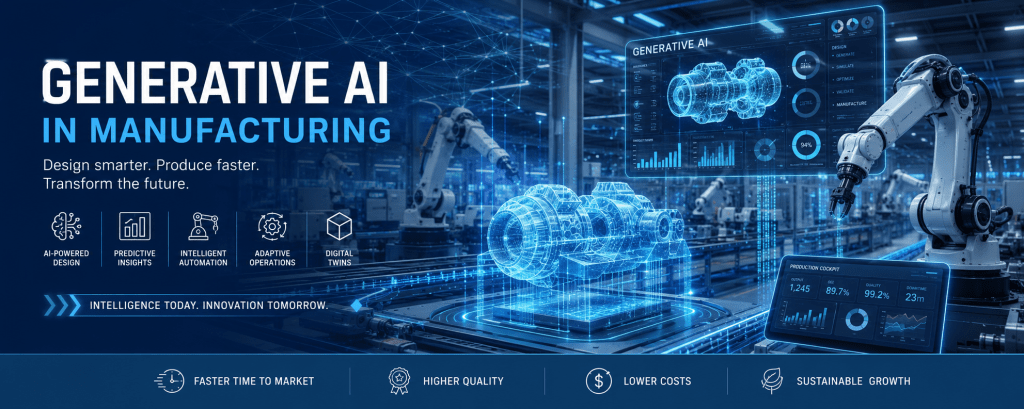
Manufacturing is undergoing its most significant transformation since the industrial revolution. The convergence of the Internet of Things (IoT), Big Data, and Artificial Intelligence is turning traditional factories into smart, data-driven powerhouses and at the center of this revolution sits Generative AI.
The global generative AI in manufacturing market is expected to grow from $630.72 million in 2025 to $13,893.51 million by 2034, expanding at a CAGR of 41%. This explosive growth is not a coincidence it reflects a fundamental shift in how manufacturers design products, manage supply chains, maintain equipment, and compete globally.
According to Rockwell Automation’s State of Smart Manufacturing report, 95% of manufacturers have either adopted or plan to adopt smart manufacturing technologies within the next 1–2 years, with 83% of respondents anticipating using GenAI in operations.
What is Generative AI in Manufacturing?
Generative AI is a branch of artificial intelligence that creates new content designs, code, text, simulations, and predictions — by learning patterns from existing data. Unlike traditional AI that simply analyzes or classifies, generative AI actively produces original outputs.
In manufacturing, this means the technology can autonomously generate new product designs, simulate production scenarios, predict equipment failures, optimize supply chains, and create quality control frameworks all from data that manufacturers already possess.
Common generative AI architectures used in manufacturing include Generative Adversarial Networks (GANs) for synthetic data generation and design simulation, Variational Autoencoders (VAEs) for anomaly detection in quality control, and large language models (LLMs) like GPT for documentation, knowledge management, and operator support.
Why Generative AI is Becoming Non-Negotiable in Manufacturing
Modern manufacturers face a perfect storm of pressures. Estimates suggest that firms will lose 45% of their average annual earnings over the next decade due to supply chain disruptions, while more than 54% of manufacturers are already facing significant labor shortages.
Generative AI directly addresses these pain points automating knowledge-intensive tasks, reducing dependency on scarce skilled labor, accelerating design cycles, and building supply chain resilience that traditional automation simply cannot match.
The global AI in manufacturing market was estimated at $5.32 billion in 2024 and is projected to reach $47.88 billion by 2030, growing at a CAGR of 46.5%. The early adopters building GenAI capabilities today will define the competitive landscape of the decade ahead.
Key Applications of Generative AI in Manufacturing
1. Generative Product Design & Optimization
One of the most transformative applications of GenAI in manufacturing is in product design. Traditional design processes are linear and constrained by human imagination and time. Generative AI breaks both barriers.
Generative design software can quickly generate a wide range of design options based on specific constraints and goals, helping speed up the design process, reduce development costs, and lead to more creative and innovative solutions.
General Motors has integrated generative AI platforms and cloud computing into its manufacturing processes to design vehicle parts and components allowing them to produce lighter components, reduce production costs, and enhance efficiency and productivity.
Engineers input parameters material type, weight limits, load requirements, cost constraints and GenAI explores thousands of viable design configurations in the time it would take a human team to evaluate a handful.
2. Predictive Maintenance
Unplanned equipment downtime is one of the most costly problems in manufacturing. Generative AI is turning predictive maintenance from a reactive process into a proactive discipline.
Tools like EOT’s Twin Talk GPT combine generative AI and edge computing to simulate events expected in an industrial environment, using that data to train machine learning algorithms that optimize equipment condition and performance.
By continuously analyzing sensor data, vibration patterns, temperature readings, and historical failure records, GenAI models predict equipment failures before they occur enabling maintenance teams to intervene at exactly the right moment, extending asset life and eliminating costly unplanned downtime.
3. Quality Control & Defect Detection
Manual quality inspection is slow, inconsistent, and expensive. Generative AI brings speed, precision, and scalability to quality control that human inspection cannot match.
GenAI models trained on thousands of images of both acceptable and defective products can identify microscopic defects, surface irregularities, and assembly errors in real time on the production line. More importantly, these models learn continuously becoming more accurate with every inspection cycle.
In 2023, Siemens and Schaeffler introduced an AI-powered copilot that assists engineers by turning prompts into working control sequences, reducing programming errors and speeding up deployment.
4. Supply Chain Optimization
In supply chain management, generative AI is used for content generation, scenario modeling, and advanced automation that enhances flexibility and communication within the supply chain.
GenAI models analyze demand signals, supplier performance data, logistics patterns, and geopolitical risk factors to generate optimized supply chain scenarios. When disruptions occur a supplier failure, a shipping delay, a demand spike GenAI can instantly model alternative sourcing strategies and recommend the best path forward.
This capability is particularly critical given the supply chain fragility exposed by recent global disruptions, where manufacturers with AI-driven supply chain resilience recovered significantly faster than those relying on traditional planning methods.
5. Digital Twins & Simulation
Digital twins virtual replicas of physical manufacturing environments are becoming one of the most powerful tools in industrial AI. When powered by generative AI, digital twins move beyond simple monitoring to active simulation and optimization.
Manufacturers can test new production layouts, simulate the impact of equipment changes, model energy consumption scenarios, and stress-test supply chain configurations all in a virtual environment before committing real resources. This dramatically reduces the cost and risk of operational changes.
6. Automated Technical Documentation & Knowledge Management
One of the most underestimated applications of GenAI in manufacturing is in knowledge management. Manufacturing environments generate enormous volumes of technical documentation maintenance manuals, compliance reports, quality records, operator guides that are time-consuming to create and difficult to keep current.
LLM-based generative AI can automatically generate, update, and summarize technical documentation from operational data. More importantly, it can make that knowledge accessible to operators through natural language interfaces enabling a new technician to query complex maintenance procedures in plain language and receive accurate, contextual guidance instantly.
7. Energy Efficiency Optimization
Sustainability is no longer optional for manufacturers it is a regulatory and competitive requirement. Generative AI helps manufacturers optimize energy consumption by continuously analyzing production schedules, equipment load patterns, and energy pricing data to recommend operational adjustments that minimize energy use without compromising output.
Germany’s “Industrie 4.0” strategy and emphasis on smart factories and AI-driven automation are accelerating adoption, with the German federal government proposing significant investment toward AI research and digital infrastructure within its national AI strategy.
Real-World Industry Applications
Automotive: GenAI is used to design lighter vehicle components, optimize crash simulation testing, and streamline PLC programming on assembly lines.
Aerospace: Complex component design for aircraft engines and structural parts, where weight reduction and material performance requirements demand exploration of thousands of design variations simultaneously.
Electronics: Circuit board design optimization, component placement efficiency, and yield improvement in semiconductor fabrication.
Pharmaceuticals: Generative AI assists in designing and prototyping applications, helping engineers explore new design options quickly and adapt to changing production needs.
Consumer Goods: Mass customization at scale enabling manufacturers to produce personalized product variants without sacrificing production efficiency.
Benefits of Generative AI in Manufacturing
Accelerated Time to Market Compressing design cycles from months to weeks by generating and evaluating thousands of design options simultaneously.
Significant Cost Reduction Reducing material waste through optimized designs, cutting unplanned downtime through predictive maintenance, and minimizing quality-related rework costs.
Labor Shortage Mitigation Automating knowledge-intensive tasks that previously required scarce skilled workers from PLC programming to technical documentation.
Enhanced Product Quality Real-time defect detection and continuous quality monitoring deliver consistency that manual inspection cannot achieve.
Supply Chain Resilience Scenario modeling and demand forecasting that allows manufacturers to anticipate and respond to disruptions before they become crises.
Sustainability Improvements Energy optimization, waste reduction, and design efficiency that support environmental targets and regulatory compliance.
Challenges of Deploying Generative AI in Manufacturing
Data Quality & Availability
Generative AI models are only as good as the data they learn from. Many manufacturers operate on legacy systems that produce inconsistent, siloed, or incomplete data creating a significant barrier to model accuracy.
Integration with Legacy Infrastructure
Most manufacturing facilities run on equipment and systems that were not designed with AI integration in mind. Connecting GenAI solutions to legacy PLCs, SCADA systems, and ERP platforms requires careful planning and significant technical investment.
Cybersecurity & IP Protection
Manufacturing data designs, processes, formulations represents significant intellectual property. Deploying AI systems that process this data introduces new cybersecurity risks that must be managed with robust data governance and access controls.
Workforce Adoption
GenAI implementation requires cultural change, not just technology installation. Operators and engineers need training, clear communication about AI’s role, and confidence that the technology supports rather than threatens their positions.
Regulatory & Compliance Complexity
In regulated manufacturing sectors pharmaceuticals, aerospace, medical devices AI-generated outputs must meet strict validation and documentation requirements before they can be used in production.
How to Implement Generative AI in Manufacturing: A Step-by-Step Guide
Step 1 Identify High-Value Use Cases Start with specific pain points excessive downtime, quality failures, design bottlenecks where GenAI can deliver measurable ROI quickly.
Step 2 Audit Your Data Infrastructure Assess the quality, completeness, and accessibility of your operational data. Invest in data cleaning and integration before model development.
Step 3 Choose the Right Architecture Match your generative model to your use case GANs for design generation, LLMs for documentation and knowledge management, predictive models for maintenance optimization.
Step 4 Start with a Controlled Pilot Deploy in one production line or facility before scaling. Define clear KPIs upfront reduction in downtime, design cycle time, defect rate and measure rigorously.
Step 5 Integrate with Existing Systems Connect your GenAI solution with existing ERP, MES, and SCADA systems. Interoperability is non-negotiable for operational impact.
Step 6 Train Your Workforce Invest in structured training for engineers, operators, and maintenance teams. Adoption is the single biggest predictor of GenAI success in manufacturing environments.
Step 7 Scale & Continuously Improve Expand successful pilots across facilities with dedicated support at each stage. Implement ongoing model monitoring and retraining as operational data evolves.
The Future of Generative AI in Manufacturing
The trajectory of GenAI in manufacturing points toward a future where the boundaries between digital and physical production disappear entirely.
Autonomous Factory Design: AI will design entire production facilities layout, equipment selection, workflow optimization based on output requirements and constraints.
Human-AI Collaborative Engineering: Design teams will work alongside AI systems that continuously generate, evaluate, and refine design options in real time based on engineer feedback.
Mass Personalization at Scale: The shift from mass production to smart customization will allow manufacturers to produce individually tailored products without sacrificing the efficiency of scale.
Sustainable Manufacturing by Default: GenAI will optimize every aspect of production for environmental performance material selection, energy use, waste reduction making sustainability a built-in outcome rather than an added cost.
Global Remote Manufacturing: Cloud-based GenAI platforms will enable manufacturers to design, simulate, and optimize production processes across global facilities from a single interface.
Conclusion
Manufacturing has always rewarded those who embrace transformation early. The shift from manual labor to automated production lines defined winners for decades. The shift to Generative AI will do the same.
From generative product design and predictive maintenance to supply chain resilience and energy optimization, GenAI is touching every critical function of modern manufacturing. The organizations that treat this as a strategic priority rather than an IT experiment — will define the performance benchmark for their entire industry.
The path forward requires the right strategy, the right data foundation, and the right implementation partner. At Xicom we bring deep manufacturing domain knowledge and proven GenAI expertise to help you move from pilot to production at pace and at scale.
Ready to transform your manufacturing operations? Contact us.
Source Url: https://www.xicom.biz/blog/generative-ai-in-manufacturing/
 AI & Tech Blogs